

Sustainable city an expensive but necessary endeavor, officials say
By KATHLEEN BISHOP Special to the Daily Press
CITY HALL — The ocean, an energy-efficient light bulb, the bus system, a homeless shelter, the Third Street Promenade, a bicycle — they all are all threads in Santa Monica’s economic, environmental and social fabric.
The idea of interconnectedness has been the primary approach to Santa Monica’s Sustainable City Plan for the past decade.
“Really what the sustainability plan is all about is looking at the entire community as a system that interacts,” said Dean Kubani, coordinator of Santa Monica’s Sustainable City Plan.
City Hall spends millions of dollars a year on sustainability — a concept most people don’t understand.
The term “sustainability” is so abstract that even those directly involved with the plan have difficulty describing it. But they are clear on one thing — sustainability keeps Santa Monica successful in just about every aspect.
“The dictionary definition of sustainability is ‘the ability to continue,’” Kubani said. “What we’re thinking about is the ability for our community to continue with a strong economy and a clean environment.”
City Hall this week is celebrating a decade of sustainability. Programs and events began Monday and will continue throughout the The plan brought all the elements of a successful society — economy, environment, development and social services — under the umbrella of sustainability.
Some of the policies and programs already were in place before the plan was envisioned in the early 1990s, and some were adopted when the plan was restruc-tured in 2001. The goal of the programs is to address critical components of Santa Monica without negatively impacting the others.
“Economic plans are looking at the best way to improve the economy in isolation; environment restoration plans are looking at restoration issues in isolation; community development and social services, they are only looking at the issues that they’re concerned with,” Kubani said. “We look at all of those things and how they interact and plan in ways that provide benefits in each of those areas.
“It really is a balancing act,” he added. Cities across the country are following Santa Monica’s lead, and are developing plans modeled after the one here.
Seattle, Wash.; Portland, Ore.; Burlington, Vt.; Boulder, Colo.; Tucson, Ariz.; Oakland, Calif.; Chattanooga, Tenn.; and Olympia, Wash.; are just a handful of cities that have comprehensive sustainabili-ty plans or are developing them.
“I think (Santa Monica’s plan) is one of the most holistic in the country,” said Linda Pratt, director of San Diego’s Sustainable Community Program, which was approved by the City Council in January 2002. “We looked at and considered many of the great things they’ve done and adapted them to meet our needs.”
San Diego’s plan will attempt to reduce greenhouse gas emissions by 15 percent by 2010. City officials work with high school students on climate prevention programs and hold public forums on all things sustainable.
San Diego’s approach to sustainability in such a large city is “one day at a time,” Pratt said.
“We look for opportunities where we can take a subject and demonstrate the social, environmental and economic components of sustainability,” she said.
The incorporation of elements other than the environment is essential to an effective and groundbreaking sustainabil-ity plan, according to Stephanie Pincetl, a visiting professor at UCLA’s Institute of the Environment.
“Santa Monica’s plan is one of the most forward-thinking in the United States,” she said. “The city has done a remarkable job in carving out areas that they can actually do something about.
“They have moved beyond simply the regular environmental things that can be done and on to the question of social sus-tainability,” Pincetl said.
Pincetl thinks strong leadership and ample information are key to bringing a city around on sustainability. She believes Santa Monica has both.
“The city understands that there is a cost benefit analysis that can be done,” Pincetl said. “There are things that cost money, but are the right things to do, and they have taken a stand that it will do those things.”
Creating a sustainable city costs tens of millions of dollars, but officials can’t provide specific numbers on how much the overall plan costs, mainly because there are so many pieces to it.
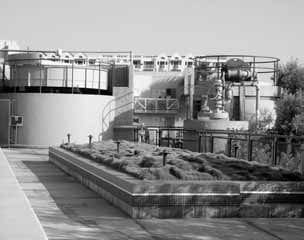
One of the largest programs in the sustainable plan is the Santa Monica Urban Runoff Recycling Facility, located near the pier. SMURFF is a joint project with the city of Los Angeles, which recycles urban runoff. It cost about $12 million to build, and costs between $180,000 to $200,000 to produce about 320,000 gallons, or 2 to 3 percent of Santa Monica’s daily consumption.
The savings, other than not having to purchase water and the ability to sell recycled water, are immeasurable, officials said. It allows for cleaner beaches, better water quality and reduced consumption of the Colorado River — all factors in a struggling ecosystem, officials said.
And while sustainability may be elusive and difficult to define, its advocates believe it’s the most practical and straightforward way to improve all aspects of a community.
“If you approach the economy in a sustainable way it might not bring in as much money as if you focused entirely on that, but our entire economy is based on the environment and use of natural resources,” Kubani said. “If you damage the environment, the economy is ultimately going to fail.”
Originally published in the Santa Monica Daily Press print edition on September 30, 2004. Read the original PDF.