

City workers combating those leaving their marks
By DANIELE HAMAMDJIAN Special to The Daily Press
Over the past 40 years, graffiti vandals have drawn a fine line between tagging and artwork.
What began as an attempt to boost morale in inner city neighborhoods around the world evolved into territorial marking by gangs. Santa Monica is certainly not immune to the practice — be it artistic or not — and has experienced a noticeable increase over the last 20 years.
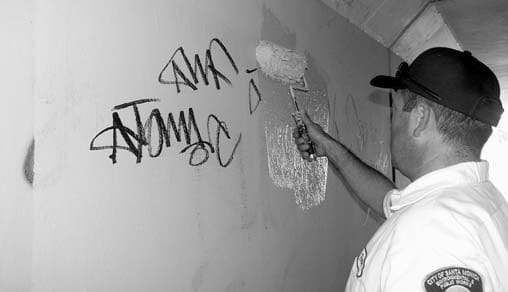
“Graffiti’s are not only from gang members, but from kids, as well as the homeless,” said Jaime Fiesco, a graffiti-removal technician who works for City Hall.
While Fiesco considers graffiti a form of artistic expression, gang members have convinced people otherwise by increasingly vandalizing newspaper racks, trash bins, telephone polls, bus benches, trees and particularly sidewalks, he said.
Removing graffiti costs Santa Monica $128,000 every year, including salaries, supplies and vehicle maintenance, according to Kim Braun, facilities maintenance superintendent for City Hall.
“The program started in 1984 on a complaint call-in basis,” she said, adding the graffiti removal program became permanent in 1988.
Fiesco is one of two employees in charge of graffiti removal for the city’s eight square miles. Santa Monica is split into two zones — north and south — with Santa Monica Boulevard serving as the divider. The Colombia-born Fiesco maintains everything south of Santa Monica Boulevard, with an emphasis on Pico Boulevard and 20th Street, an area he believes is the worst to clean up.
“The north is getting bad, too,” said the 43-year-old Fiesco, adding that Wilshire Boulevard is also an inviting target for many graffiti vandals in the northern part of the city. “They like to do busy streets so everyone will see.”
When they are not patrolling, the removal team relies on a hotline set up by City Hall for residents, though the tipline is utilized primarily by other city employees. Fiesco relies on support from staff members at the pier, the beach, the Third Street Promenade and especially the local parks, where vandalized bathrooms are a daily issue.
The graffiti hotline registers between 10 and 20 calls every day. Removing graffiti can take up to 20 minutes, depending on the size, location and type of spray paint. Fiesco said the most frustrating part of the job is watching newly built properties being disfigured.
“For now, there is nothing we can do about this,” he said, pointing to the green fence surrounding a church on Maple and 16th streets. In order to remove the tags, they would have to re-spray the same color as the entire fence. Fiesco believes neighbors are likely to complain because of the odor and stains on nearby parked cars the spraying might generate. In that case, the city must put a sign up that indicates the area will be inaccessible on specific dates.
The most difficult graffiti to remove, and infamous among many Santa Monicans, is one that is spray-painted over a mural like the one under the overpass on Third Street and Ocean Park Boulevard. In order to restore the mural, City Hall has to contract private paint removers. Though many residents have spoken out about the graffiti, the city has yet to remove it.
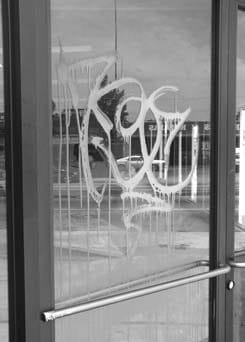
Fiesco, who has been working for the city for the past 14 years, has noticed recently a new acid-based product that’s used on windows of commercial properties.
“They like it because it’s impossible to remove,” he explained. The new tool Fiesco refers to is known as “acid-etching,” a dangerous cream that can cause deep, penetrating burns to the skin, eyes and lungs. If a person is found carrying it, they will be charged with a felony, police said. Acid-etching also appears on glass bus shelters. The effect is irreversible and, as a result, the windows have to be entirely replaced.
The most common graffiti tags Fiesco sees is “SM13” or “SM17,” a territorial mark by one of the two main Santa Monica gangs. Other notable markings include “CXC,” “CaCas” or “KaKas,” which are meant to insult gangs from Culver City and “Vergas” — a derogatory term aimed toward Venice Beach gang members.
“It’s never going to stop, but you can try to control it,” Fiesco said. During his seven years as a removal tech, Fiesco experienced one encounter he is not likely to forget. Two years ago, as he was covering up an “SM” graffiti on a wall in the 2100 block of Pico Boulevard, a man in his early 20s threatened him with an anti-theft device, known as The Club, if he didn’t immediately leave the area. Fiesco said he ran away and didn’t look back.
The appearance of graffiti in a neighborhood not only increases fear among residents, but it reduces property values, police said.
Just like the Adopt-A-Highway initiative, the city’s maintenance management division has created the Adopt-A-Block program to help stamp out graffiti in Santa Monica. An individual, community organization, business, school class or other group can adopt a block — private or public — and receive a kit containing graffiti removal material. To sign up for the kit, contact (310) 458-8524. To report graffiti, residents are urged to call the hot-line at (310) 458-2231.
Originally published in the Santa Monica Daily Press print edition on July 10, 2004. Read the original PDF.