

Giving back to the community isn’t all that it’s cracked up to be. Especially when it’s court-ordered.
Giving back to the community isn’t all that it’s cracked up to be.
Especially when it’s court-ordered.
I recently found myself on the other side of the law and having to do 24 hours of community service. I thought cleaning up the beach, which I use nearly every day, would be a way of giving back. So the judge replaced my $450 fine and sentenced me to the LA County Beaches and Harbors.
I figured cleaning the beach wouldn’t be all that bad. But when I found myself spraying the walls down with a garden hose in the Topanga State Beach bathrooms during a surf contest one Saturday morning, I realized that I had been in a state of delusion. The courts may call it “community service” but it’s a little more down and dirty than that.
The program, which handles tens of thousands of people every year, is designed to deter you from ever committing another a crime and at the same time, it saves Los Angeles County millions of dollars in labor costs. Us “court referrals” get time to think about what we’ve done, feel a little pain while doing manual labor and contribute to our communities whether we want to or not.
That’s the difference between community service and community volunteerism — and it was no more apparent than it was on my second day. I was raking an embankment and trimming hedges in a criminally orange vest, and just a few feet away were dozens of families picking trash up as part of a worldwide beach cleanup effort.
I felt like a criminal. But I’m not. I’m just stupid.
Earlier this year, I was stopped by LAPD for driving with an expired license. I let it expire because I told myself I never had enough time to go to the infamous Department of Motor Vehicles and get a new one. That was bad thinking because, not only did I have to sit at the DMV for six hours when I finally did renew the license, but I spent four hours in the courtroom waiting to answer to the charges and another 24 doing manual labor.
If there was one thing I learned from my experience, it’s that if it wasn’t for criminals, the beaches would be a mess and taxpayers would be footing the bill to clean them up.
And while most people in the work program are criminals, some of the ones I worked with weren’t. Most maintained their innocence while others admitted their guilt. All of them couldn’t believe that I was there for such a small infraction. I worked with a Harvard graduate who had a propensity to drink and drive and an established freelance writer who was falsely accused of shoplifting a bottle of champagne at Costco. He refused to pay the fine on principle and took six days of community service.
Nearly 20,000 people worked the beaches from Malibu to the South Bay last year and most of them were convicted for driving without a license, DUIs or petty theft. Most juveniles are often sent for smoking and curfew violations.
Last year, the South Bay/Harbor/Long Beach Beaches and Harbors Volunteer Center — which handles the Santa Monica Bay — saw 18,797 court-referral cases. That includes 1,090 juvenile cases, said De De Hicks, president and CEO of the center. That was an increase of about 5 percent over the previous year. Now more than ever before, the county sentences DUI offenders to the hospitals and morgues to teach them a lesson. (See related story, page 3).
And while I only had to do 24 hours, most people serve between 100 and 150 hours, according to Sandy Montalvo, director of the court referral community service program in South Bay-Harbor-Long Beach. And while I wasn’t asked, some offenders can serve in schools, hospitals, at Red Cross blood drives or for any nonprofit organization.
Montalvo said they refer individuals, but the nonprofits ultimately make the decision as to what type of offenders they are willing to work with.
Even though it may have been one of the worst experiences in my life, I’m glad I did it. It’s a character builder and, what’s more, I appreciate the program’s fundamental goal even more — putting people to work and making them understand there are consequences for their actions.
466,I know it works. I can guarantee everyone I worked with doesn’t want to go back — ever. After cleaning public toilets, they might think about their painful experiences and not shoplift or get behind the wheel after too many cocktails.
But the ones with experience know how to milk the system. And seeing as though I didn’t feel I deserved to be there, I was all about making it work in my favor. So I listened to the seasoned workers and kept my mouth shut.
The first rule in community service is to work as slow as possible. I learned that when I showed up at 6 a.m. at Will Rogers State Beach and met a UCLA graduate named Sandra, who had already logged plenty of hours in her 19-day sentence. When I asked her what she had done, she replied, “I pulled a Winona Ryder.” It turns out Sandra, who earned her bachelor’s degree in communications and is now studying for her master’s degree in psychology, eyed a pair of cute jeans at Robinson’s May in Westside Pavilion Mall. But they were too expensive for her taste, so she took them. Being a novice criminal, Sandra got caught.
Her advice to me was work “slow and steady.”
453,I knew it would be hard for me because, as a daily newspaper editor, I have to get a lot done in a short amount of time. I’m not accustomed to wasting time and working slow. But I dealt with it. I gazed out a lot at the ocean, watching dolphins play in the surf at Zuma Beach and daydreamed. I worked at a snail’s pace and took advantage of my cell phone’s free weekend minutes to catch up with old friends.
The county workers who supervise us took it easy on us most of the time. Some of them let us slack off a little, but others watched us like hawks, and they are the ones who know about the “slow and steady” rule.
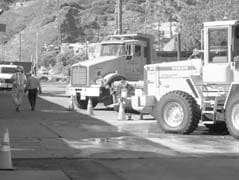
My third day was by far the worst — I mopped up puddles of urine and piles of feces in a beach bathroom just north of Gladstones on Pacific Coast Highway at 6:30 a.m. I did all of the bathrooms that day — at Topanga State Beach, Will Rogers and the beaches and harbors maintenance shop. My criminal colleagues got to sweep stairways and empty garbage cans. Towards the end of the day, I was thrilled for my last assignment — detailing the inside of the tractors used to comb the beach.
There were some things I just refused to do, like picking up used condoms on the side of the PCH.
The first day was the easiest — I got the creme de la creme of assignments — Malibu, where everything is easy. Myself, Sandra, and Michael, a travel writer, spent the morning sweeping the maintenance yard. Then we hopped around other small, out-of-the way beaches, sweeping the stairs there. I found some new surf spots and Sandra and I flirted with a couple of surfers. We may have had a chance if it weren’t for those damn orange vests that we had to wear.
It was while we were sweeping the stairs that I realized how inefficient the government really is. Three of us swept the same staircase. So when I had completed the middle section, I had swept sand onto the portion that Sandra had already swept. And everything I had swept, Michael had swept new sand onto.
Even though it was community service, I still took pride in my work. I actually found myself trying to please my supervisors. So it disturbed me on my second day when Jose made me do the men’s bathroom over at Topanga because I didn’t mop the floor well enough.
After three days, I was thrilled to be back at my desk at the SMDP, working morning, noon and night.
After that experience, I can honestly say I love my job.
Originally published in the Santa Monica Daily Press print edition on November 3, 2003. Read the original PDF.