

COMMUNITY PROFILES
By SUSAN TAM Special To The Daily Press
Certain scenes in life should be reserved for movies, like the start of a slow round of applause, the game-winning score at the buzzer, or the rousing speech by a teacher who inspires a struggling class.
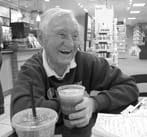
An afternoon spent with Santa Monica resident Art Verge fits that cinematic criteria — a surreal experience that is part golden era, part surprise ending and, ultimately, heartwarming.
When Verge sits down to talk, people listen. By the time he finished his Daily Press interview, he was regaling a small audience at Borders Cafe, having commandeered the attention of passersby and employees alike with his tales. Verge arrived with a list of anecdotes and vignettes about his life that had gotten so long it started from his notepad and continued onto the palm of his hand. The father of five confessed to adding to it even while on the golf course that morning.
Tell me about yourself. When were you born?
“I was born in Santa Monica in 1927 at the Santa Monica Hospital. My mother was born here in the late 1800s in Santa Monica, and it was kind of fun being raised in Santa Monica. Not everything was perfect, but most things — it was like Camelot. It was very positive growing up, except for a few situations that we all had, and we lived in a very nice home.”
What was life like during the Depression? “The Depression, that’s what I remember first growing up. People would come into our house and ask for little jobs. We lived at 20th and Carlyle, and you say, ‘well, that’s a nice area.’ I’m not sure if it was expensive then or not...
Then one day, I asked my father, ‘What’s that on the curb, that ‘X’?’ and he said, ‘Maybe I shouldn’t tell you this, but people that are out of work, if they see a chalk mark on this house or that house, means they’ll give you a job’... if you’ll mow the lawn, or let’s say, pick up the leaves or something like that. Maybe it was fake and he put it there. It was a hard time for maybe my parents, and yet I never really felt it.”
What was Santa Monica like during the war? “As I got older, life changed a little. People were being hired at Santa Monica Douglas, which was the advent of World War II in 1939, when Hitler invaded.
Literally, it was such a transition to see camouflage after Pearl Harbor, they would have camouflage nets above Ocean Park Blvd. It looked like grass above you and people would be parking there to go to work at the Santa Monica Douglas Plant.
You would hear these airplanes all the time (makes plane noise) as you were going to bed. You’d hear the regular shift, the graveyard shift, people would just work. There were all these jobs at Santa Monica Douglas. People would come in when I was at St. Monica’s High School asking, ‘Would any of you young men like to work the evening shift, four hours?’ and you would work to help the war effort. (These are) stories of what Santa Monica was like during this chaotic period, and yet, you say, ‘you must have suffered’ and I say, ‘no.’ During war, we would still be going to the Aero, and we would go see Hopalong Cassidy movies and who knows what. It was very nice, Camelot. I keep overusing the word, very tranquil, or whatever the right word is. There were so many things I liked about growing up here.
You served in the Navy. How long did you serve for? What was that experience like?
“At the end of World War II, I turned 17 and both my mother and father died of cancer, basically, and I joined the navy at 17. And my biggest action during WWII, the last few days of it, literally, was to take a ship, YO 45, and to take butane out to an island behind Catalina. The battle of Okinawa was just ending. All of a sudden, on this little ship, going out beyond Catalina and San Clemente, ‘goes ding-a-ling, ding-a-ling.’
And here you are, you’re 17, in your senior year of high school, so I run up to the deck and I started loading the ammunition into the ship’s 20mm guns, and the chief looks at me and says, ‘What the hell are you doing, Verge?’ I said, ‘It’s battle station still.’ He said, ‘The tuna are striking. Get me my fishing pole.’... His exact words.
And we stopped. The ship was going about eight knots an hour and goes down to two knots and we start fishing. It was the craziest thing I’ve ever seen, that people are dying 7,000 miles away on the other side of the Pacific, and here we are fishing for tuna [cracks up laughing].
Then, when the war did end, I got discharged and they let me go back to St. Monica’s and I didn’t have a parent, so I said to the nun, ‘Sister, I want to use my G.I. Bill. Could I finish my senior year here, and maybe do something?’ And she said, ‘You go down to the school cafeteria and work, and it will be all taken care of.’
I have a serious debt, in my mind, to St. Monica’s High School. They let me just go there. They fed me at lunch because I was serving lunch with Mrs. Grant, so I had a very nice senior year, where people said, ‘You’re a veteran?’ and I said, [in a deep voice] ‘Yes, yes I am.” [laughs].
How long were you in the service? “Thirteen months, 13 days. I was lucky, some other people weren’t so lucky. If you joined the war during WWII, there was a rule that you got two years of free college, and for every day in the service you got one more day of college besides for two years. So, accrued together you’re not going to get four years, but there was also a rule that if you had run out of money from the G.I. Bill you can finish your last year. So I went to St. Mary’s.”
You started out at Santa Monica College as a water polo coach before you began to teach. How did you get that job?
“Wade Thomas asked me, ‘Would you like to come on as a counselor and swimming coach?’ And I said, ‘what do you mean, swimming coach?’ And he said, ‘Well, you were in college and you were a lifeguard, you must swim a lot.’
He told me that he needed a replacement for another professor that was on sabbatical for a year. I said, ‘I would be the worst coach possible.’ And he said, ‘Well, you played water polo.’
He asked if I could get the water polo team on the college bus and I said ‘yes.’ He said, ‘Okay, you’ve got the job,’ and that was it, and I’ve been at Santa Monica since that time.”
Lifeguarding was very important for you. You did it for 16 years and have so many stories, including trying to protect JFK.
“I had that permanent job as a lifeguard. I would go to work on the 15th of June up to July 7th, and since I have an education degree, they made me a junior lifeguard instructor. So in Santa Monica, for no other reason than by circumstance, people knew me... those days at the beach, jumping off (different locations), going up to Secos.
President Kennedy used to come to Santa Monica quite often. His son-in-law was here. He would come to Peter Lawford’s house at the beach. What happened was, he would go in swimming, and people would race to him so they, too, could go swimming in front of Peter Lawford’s house. And they needed a lifeguard to sort of look out after them. Well, the lifeguard before me would go back and have a drink (and leave), and so they said, ‘Verge, you have five kids, can you take over that guardianship?’ Well, they put me there, and John F. Kennedy never came out of that presidential home, so I never got to see him. And then you see this picture in a LIFE magazine article where you see literally these people running around the President, and the lifeguard wasn’t showing up and they are trying to touch him. The FBI didn’t know what to do. They couldn’t put on swimsuits to go in the water and protect him. It was a fun period in my life, and I thought, ‘Why are they putting me here and I get paid for doing nothing because he won’t come out?’”
So two of your sons guard too. Tell me about your family. “Things just kept going along so well, and then one of the most fun things that happened to us was that we kept having children, which was great. We never did anything to prevent them, and Marge (my wife) is the easiest-going person in the world. We ended up with five nice kids.”
Besides everything you do, you also take time to take SMC students abroad to Europe.
“Me and the other professor and the wives always go, but (this time) I also wanted LaRue Muhammad (another SMC official, who is Muslim) because I wanted someone of a different background. You see people all the time — new faces, new people. When people from Sumatra or Japan or anyone else try to get into my speech class and it’s closed, I’d gladly take them. Because sometimes we grade them on how well they speak English, and how can they? They know two languages, and I only know one, and not that good. It’s good to have them in the class. I love to hear minorities from South L.A. say that they love the class because they see students from Africa, Arabia, Ukraine and, literally, I’ll go recruit them sometimes. There are so many different people, nationalities. Why are there wars when there are such beautiful people, from [pause] Syria? Or any place they live? The nice thing about life is that you could make it any way you want.
And you were president of the Kiwanis. “I was president of the Kiwanis in 1978. I’m name-dropping. I must be insecure. We might have 100 members or so, and they weren’t electing you to bore them, they elect you because you’re going to get good speakers, and so on. One day, one of them came in and asked if someone could speak for us, his name was Tom Brokaw. He wanted to be better known in the community to the leaders, so he was maybe 29 or 31. Since then, it’s been so much fun to see his career skyrocket.
You’ve really enjoyed yourself and seen interesting people while living here. Who else have you met?
There was a movie actress in the 1930s called Shirley Temple, and she lived in Santa Monica. She lived two blocks from me. Shirley Temple’s father was with Bank of America and my father, who was a lawyer, knew each other, and would get together. Yet, I would be expected to sort of join in the conversation, and here you are about 8 years old, and my dad would say, ‘Why don’t you and Shirley go swimming or something?’ And she would say, ‘You want to see my doll house?’ I would say, ‘No, no, I don’t want to see your doll house.’ It was a pretty period, and she lived at the corner of Georgina and 19th, where maybe you shouldn’t be living, but it was not a good time for many Santa Monicans in the 1930s. We lived (where we did) because my father had a job. I was really spoiled with a loving mother, with everything.
We were just talking about dating, and first kisses. Back then, if you kissed a girl, that was wild. Not on the first date, maybe the second or third. It was the age of innocence. You didn’t have a chance to be bad. Everybody was your brother’s keeper. You go on the buses, you almost have to be interlocked with society, you hitchhiked places. In those days, you hitchhiked and it was okay. The war took all the gas away, and people who hitchhiked were considered heroes.
What do you think of times now? When I talk about the golden era and all that, well I really think today is just as exciting as yesterday. It’s fun. The good ol’ days — maybe they’re today.”
Originally published in the Santa Monica Daily Press print edition on December 6, 2004. Read the original PDF.