

Legoland lovers search for employment and enjoyment
31st STREET — Looking for a career as a professional Lego builder?
Well, the chance to be discovered in Santa Monica has passed.
But not for Stephen Lau. Lau, 21, was among some 100 enthusiasts who came to Santa Monica on Monday to apply for an opening as a model builder at Legoland in Carlsbad. Each builder was given a tub filled with 2,000 Legos and told to construct an animal of their choosing in 45 minutes or less.
“It’s an opportunity for me,” said Lau, an accounting student at the University of Southern California. “I’ve always been playing with these as a kid. And I kind of watched it evolve from playing into tools.”
Lau wasn’t alone. Organizers for the “Master Model Builder Search,” which has been through nine U.S. cities and makes its last stop in Orange County on Wednesday, said more than 400 people pre-registered for the initial “interview” nationwide and many more have simply dropped in.
“It’s free. It’s a job interview — if you think you’ve got the stuff and this is what you want to do,” said Francine Marseille, a spokeswoman for the Art Institute of California on 31st Street, where Monday’s contest was held.
The designer ultimately chosen by Lego officials will join an elite team of six in charge of creating, designing and maintaining the more than 5,000 Lego models at the park in Carlsbad. Those models range from miniature people made up of only a dozen pieces to whole cities that are built out of more than a million. Some take four months or longer to build.
Stacy Slingerland, a spokeswoman for Legoland, said the next addition to the team will start at $13 to $15 an hour, but will be eligible for better-paying promotions. Many a builder have made a career out of playing with Legos, she added.
“For most people trying out, it’s not about the money,” Slingerland said. “It’s about having the dream job... but some builders that have been there a while do make good money.”
Eighty percent of Legoland models are done freehand, using a specialized “Lego brick paper,” designed like graph paper but tailored for Legos. The other 20 percent are designed with computers, using custom programs not available to the public. New hires start their jobs gluing together models and can move their way up to become a model builder, model designer and, ultimately, a supervisor, Slingerland said.
Dan Bennett, 28, who started as a Lego designer six years ago in the U.K., was among those judging the hopeful builders. Asked what he was looking for in the applicants, Bennett said, “Structure is a very important part of it — and complying to the theme. It’s imagination as well. We like to see an element of humor.”
Bennett said the judges were less concerned with color coordination and more with the applicant’s ability to make three-dimensional figures out of blocks. He said model designers and builders come from a wide variety of backgrounds, but they all have one thing in common — they love Legos.
“It’s great,” said Bennett, who has a degree in art design. “You get a chance to play around with bricks all day.”
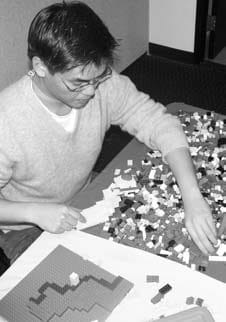
Originally published in the Santa Monica Daily Press print edition on January 6, 2004. Read the original PDF.