

By GENEVA WHITMARSH Daily Press Staff Writer
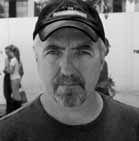
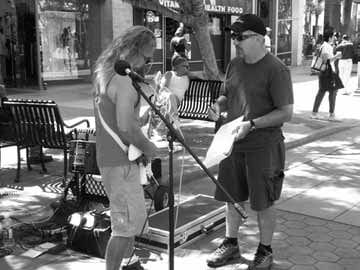
PROMENADE — Stephen Bradford winds his way through the thousands of people walking the Third Street Promenade and stops to chat with a guitarist who plays for the crowd.
“How ya doin’ today?” he asks the musician, extending his hand and looking him in the eyes.
The guitarist smiles and takes Bradford’s hand. They chat briefly before Bradford moseys on, looking to connect with each of the performers who have set up shop on the Promenade that day.
Bradford is the Bayside District’s venue manager, a job that entails making sure the street performers, solicitors and other people who use the Promenade to reach out to the public are complying with the city’s 15-page street performer ordinance. For example, performers must change locations each two hours, be a certain number of feet from each other and not exceed a certain noise level.
The 54-year-old former San Diego resident brandishes neither a badge nor a gun, crediting a sense of fairness for helping him earn the respect of the people he encounters each day on his beat.
What does your job entail? “My title is venue manager. I’m not an enforcement person — enforcement is left up to the police — but I track the time and position of all the performers on the Promenade. It’s my job to see that they’re in compliance... The key to the whole thing is rotation. On the even hour — two, four, six, eight, 10 and 12 — everybody rotates. It doesn’t matter when you started. If you started your performance a quarter to 12, you have to pack up and be gone at 12. That allows anyone who wants to participate access to a spot on the Promenade. A person cannot lay claim to a spot — they have to move. Everybody.
Just having said ‘everybody,’ not everybody moves, because there’s a category of people called Heartland Vendors, and it’s called that because of a court case. They are free speech performers, or advocates, and are using their free speech rights on the Promenade. There are several of these people, and they don’t rotate.
It’s a public street, so anyone who wants to say anything can stand out there and do that to their heart’s content all day long, but once they set up a table or musical instruments to perform for the benefit of the public, and are taking money, then the city has some right to say where they are, how long they’re there and how loud they can be. So rotation is the key.
You can’t return to a spot you were at previously or a spot within 120 feet of that spot but one time in a six-hour period. There’s a real key distinction I need to make between monitoring and enforcing. I don’t have the authority to write tickets. I don’t have the authority to remove anyone’s permit. I don’t have any of that authority. I am the monitor, or the liaison between the performers and the police in the city, and the performers and the store operators and cart operators. Another essential aspect of the ordinance is the noise limits. It’s my job to make sure everyone is performing under these limits.”
So, if speakers are blaring, you let them know the limit?
“Right. And I have a couple different ways to monitor that. I have a relatively inexpensive Radio Shack-style meter that registers continuous volume. If I’m listening to something and having people turn it down, the needle will register that so we know they’re at the level where they need to be. And then I have access to a very expensive, very complicated piece of machinery that I still don’t know exactly how to use completely, and hopefully — in the off-season this fall — I’m hoping to take a class to learn how to use that machine better. But it’s a very sophisticated sound meter that can tell you within a tenth of a degree how loud a person is, and it’s the meter that the police use.”
How did you end up in this position? “I heard about the opening and applied.
I come out of a background of 25 years of freelance video production in many different areas such as government, education, business and litigation, working as a producer creating animation, graphics, video, film, an occasional commercial, an occasional music video. I started as a PA and did writing, producing, directing, editing. This job is very much like certain aspects of the production world. I compare it to being the production manager on a shoot that never ends, because there’s no script but there’s 100 performers. Actually, the city has issued over 1,000 permits. I have no idea how many are going to show up. I have no idea what kind of mood they’re in, no idea if they’re having a terrible day or a wonderful day. I have no idea if they’re going to be in full compliance of all the rules or whether it’ll be a headache from start to finish. With that many people, there are some people who don’t want to be told what to do, and there are other people who appreciate the opportunity so much to be here that they never give me a hint of trouble.
It can get a little tricky because it’s a 15-page ordinance of things they have to be aware of, such as the spacing between performers, how late they can play on a certain day, and the noise section of the ordinance changes during the week and during the day. So at 4 o’clock on a Tuesday afternoon, you can’t be as loud as you can be at 4 o’clock on a Saturday afternoon or 9 o’clock on a Sunday night.”
What is your typical day like? “I have a kind of crude map of the Promenade. There’s three blocks, and using different color pens, I track where everyone is in any two-hour period. What I like to do typically is anticipate the changeover by 10 or 15 minutes, and if I see someone who has two giant speakers and a lot of equipment and it’s five minutes to two, he’s not going to be done in time and the setup and breakdown part of the act is part of the two-hour performance block. So, I have to anticipate that change over a little bit, and since there’s only one of me for three blocks, I like to get out there a little early. And then there are times on a busy Friday or Saturday where I’m pretty much out there solidly from 6 to 10 (p.m.). last few weeks have been extremely busy, and I’m anticipating that we will kind of peak with Labor Day, and then it picks up again as the holidays approach, and then there’s a lag time in the winter and then again in the spring it starts to pick up.”
Did you grow up in Santa Monica? “No, I grew up in California. I’m from San Diego, went to college in San Francisco. But I’ve been here since 2000.”
Do you like living in Santa Monica? “Oh, yes. In fact, my grandparents moved to Santa Monica in the mid ’70s, and being a production person in LA, I’d just be all over the place and would end up working in Santa Monica sometimes. I lived here in the mid ’80s for about a year and then since 2000.”
Do you see the city differently since you’re seeing more of its more colorful characters?
“You know, it’s amazing. A lot of people live in a community but work outside that community — like I have done most of my life. This is the first time I’ve been able to live and work in the same town. I live nine blocks from here, so I can walk to work. It’s wonderful. But it also just gives you such a different perspective of the city you live in. If you’re working eight, 10, 12 hours downtown and you live in Santa Monica, you get back here, have dinner, go to bed, get up and repeat. But to live and work in Santa Monica is incredible, and I get to see so much more of how the city works.”
What have you learned about the city? “Well, Santa Monica has the reputation of being the home of the homeless, and there’s certainly that aspect of things, but that can become sort of a stereotype that’s not really true. There’s all kinds of people here — every race, every creed. We have, since it’s an election season, the Republicans out on the Promenade, and to see the numbers of people they’re attracting and talking to … You sort of think that people think of Santa Monica as being so liberal or so left wing, but it’s not that completely. It’s all kinds of things. It’s all kinds of people.
I’ve learned that parking is a real hassle, of course, so it’s nice to be able to walk to work so I don’t have to deal with that. Just being able to go to local stores and shop locally, go to the Farmers’ Market. I’ll be walking to work and people will be driving by, honking or waving. I originally asked (my supervisor), ‘Am I going to have to wear a badge?’ and she said ‘no,’ within a week everyone will know you.”
What kind of person do you think it takes to do this job?
“You really have to be non-judgmen-tal in a basic way because you just encounter so many different people in so many different areas of their life — young people, middle-aged people, people just starting out, kids with attitudes. I’ve just met so many different kinds of people. You have to really not give into the sort of preconceived notions or prejudices that you’ve built up, because it’s just not true.
You encounter people who have been doing street performing for 25 years and they know a lot more about it than I do, and I can’t come into this job saying I’m the big cheese. In fact, I have a tremendous amount to learn about what these people go through daily to get here. We have a lot of immigrants who are here performing, people from South America, people from Asia, people from all over. These people are so grateful for this opportunity. It really makes you kind of stand back and take stock of what we take for granted about living here. Just classic immigrant stories of people arriving here with nothing and being given the opportunity to perform for the city and really enjoying it and making something of it.
You need someone very flexible, who doesn’t make snap judgments. One of the things my job entails is probably 10 to 12 times a day I’m resolving disputes among performers, or among performers and cart operators, or between performers and store owners. And so it’s like being a diplomat, I have to look into both sides of the story and make a fair judgment.
I can give you an example: We were having a hassle with one of the political groups on the Promenade. They set up in the wrong locations. Part of the ordinance dictates to these folks where they can set up on the Promenade for safety reasons. I arrive on the scene, and these guys are going at it with the police. When I arrived, the person arguing with the police said, ‘OK, I will do whatever he says,’ referring to me, and the reason he said that is for several weeks I’d been very fair in making sure their table was correct, making sure they didn’t have too many signs, making sure that people who disagreed with their point of view weren’t in there hassling them too much. So, as a result, instead of automatically doing what the police told him to do, he said I’ll do what he tells me to do.
I’ve said that all the authority I have is a clipboard. I don’t have a badge, I don’t have a gun, I don’t have anything that automatically says to anybody that they must do what I say. I need to rely on building relationships with the folks that are out here and establishing relationships with the people who are out here for the first time. Virtually every day there’s someone who’s never done this before and here comes this strange person who you can’t automatically identify as a city official. I have to convince them to do what I tell them to do in a sense, so it is the most difficult, challenging job I’ve ever done.”
Do you have any notable stories from your work out there?
“There have been three arrests of either performers or people on the Promenade. I just never have been in a situation where I’ve ever even been close to an arrest, not personally, not professionally — nothing. So to be thrown into a situation — I mean it’s a public street and there are a lot of wonderful things going on and horrible things going on. There’s crime, all kinds of stuff, so having to call the police and have them come out and arrest someone on my say so has been very traumatic and difficult. In all cases, it was absolutely necessary to do.”
Where do you see yourself in the future?
“I have no idea. It’s a funny position because there are things in the past that qualified me, but it’s a unique position as well. This is almost a unique situation in the country in terms of performers. There is no other venue that I know of in the country where $37 a year gets you virtually unfettered access to these three blocks and this many people going by. People who have been doing this a long time tell me just what an incredible place and great opportunity this is. They say we have a great system here. There’s nothing else like it.
I take it day-to-day. I’m here day-today, making sure this weekend or this day goes well.”
Is there something you really wish the community knew or was aware of?
“When I told people I was taking this job, every one of them said, ‘Oh my God, the Promenade. I never go to the Promenade. I hate the Promenade. It’s full of — take your pick — homeless, drug addicts, crime.’ So, if there’s one thing I can say to people in Santa Monica, it’s that the Promenade is really a wonderful, wonderful place and it’s full of incredibly talented people. It’s like vaudeville. It’s the bedrock of entertainment in this community, in Los Angeles and in the country because anyone can come out here and do it. Anyone who has the desire and pays $37 a year — that’s 10 cents a day — will not only have a place to perform, but there’s a system in place to protect them while they’re performing and assure them they get a fair shot. And as a result, we’ve attracted some tremendously talented musicians and artists, jugglers, mimes, rap artists. It really covers the gamut. So I would say to people in Santa Monica — don’t give up on the Promenade. Come down here and enjoy it. It’s not nearly as loud and stinky as you think.”
Originally published in the Santa Monica Daily Press print edition on August 30, 2004. Read the original PDF.