

Tonight’s rare meteor shower has roots dating back to 4 A.D.
By GERRY SHIH I Special to the Daily Press
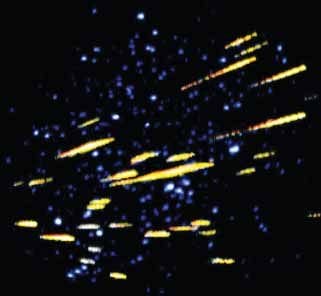
Wistful exes, conscientious dreamers or just plain greedy Santa Monicans will have several dozen chances to make a wish tonight, as the Aurigid meteor shower sprays shooting stars across the night sky.
Shortly after 4 a.m. (Saturday morning), nocturnal denizens of the western United States, Canada and Mexico should be able to witness one of the most spectacular meteor showers in years.
According to the latest calculations from the NASA Jet Propulsion Laboratory, the mysterious Comet Keiss passed by the sun around 4 A.D. — not 83 B.C., as previous reports indicated — and left countless chunks of debris in its wake. As the Earth crosses paths tonight with that trail of debris, the 1,600-year-old bits of frozen comet jetsam will burn as they collide with the Earth’s atmosphere, creating visible streaks of light.
The meteoroids will approach Earth from the northeastern part of the sky that is occupied by the charioteer constellation, Auriga. Since Keiss is a “long period” comet, by definition it does not come close to the sun for thousands of years and, therefore, keeps a pristine crust. Consequently, the meteors that do break off of the crust of the Comet Keiss may be formed by billions of years of cosmic ray exposure and may emit a unique blue-green light as it burns in our atmosphere on Saturday morning.
As could be expected when dealing with astronomical dimensions and mind-boggling models, scientists have disagreed about what we may see tonight, leaving some room for error in their calculations, since some models for predicting meteor showers are not yet fully developed.
“Almost anything could happen, from a fizzle to a beautiful meteor shower,” said NASA astronomer Bill Cooke.
In 1994, when Earth last encountered this debris stream, veteran Southern California meteor watchers Bob Lunsford and George Zay reported bright blue-green meteors in a vivid but short-lived shower. Another observer spotted this same stream in 1986.
Robert Lozano, vice president of the 50-member-strong Santa Monica Amateur Astronomy Club, said he and his colleagues weren’t taking any chances.
“You have to go,” he said. “It could be a big dud, but hey, what if it’s spectacular and you miss it? You’ll kill yourself.”
Lozano, a bodysurfing and diving afi-cionado, sympathized with the researchers’ unenviable job of trying to predict something that is near impossible to pin down.
“It’s like judging the waves, they’re like surfers trying to catch the big surf, but you don’t know what might happen,” Lozano said, trying to find a Santa Monican analogy.
Peter Jennisken,a meteor astronomer at the Bay Area-based SETI Institute,said that watchers this weekend can expect meteors falling at a rate of 200 meteors per hour for a 10-minute peak period around 4:36 a.m., and then 100 meteors per hour for another 25 minutes.
He added that it is best to observe the shower at a location where there is less smog and the moon is not directly visible, because the moonlight can reduce the contrast of the bright meteors against the dark sky.
“It’s much better view from somewhere above the city smog because smog scatters the moonlight and makes the sky brighter,” he said. “But it’s not impossible. Just make sure that the moon itself is blocked by a building or tree when you look.”
Lozano and his club are taking it one step further. He blamed Santa Monica’s “inefficient” street lighting setups for creating light pollution, and suggested that serious viewers head to Mount Pinos near Frazier Park, a good two-hour drive north of Santa Monica.
While the shower is merely another beautiful spectacle or a chance to make a wish for most Santa Monicans,astronomers will be seizing the opportunity to reinforce some shaky models and confirm hypotheses. Jennisken will lead a team of 24 researchers on two Gulfstream jets to take pictures and videos of the meteors at 45,000 feet. The team will point everything from regular consumer-grade digital cameras to observatory-grade equipment and night-vision lenses out the cabin windows to collect as much data as possible.
“Only in the last 10 years has it become possible to make predictions for unusual meteor showers like this one,” he said. “We’re trying to confirm that the shower has returned, and measure when it peaks and how bright the meteors are going to be. All the information we collect on Saturday morning can confirm that we did the modeling correct.”
Jennisken said that this is the very first meteor shower from a long-period comet ever predicted. Because models from NASA, SETI and CalTech have shown that the Earth’s orbit will not intersect again with this meteor stream until far past 2100, astronomers have also encouraged ordinary watchers to participate in the research by taking pictures and homemade videos and submitting them.
“Chances are that one of you, not us, will catch the brightest Aurigid out there,” he said. “Who’s going to have the picture with the brightest meteor in it? That’s a great thing to try to do with your digital camera.”
As only three people have seen this meteor stream in recent times, potentially anybody could be the fourth living person to witness an Aurigid meteor. Factor in the unique properties of the meteor and its significance in astronomy, and each of us has the chance to grab a chunk of history.
Originally published in the Santa Monica Daily Press print edition on August 31, 2007. Read the original PDF.