

They had to admit they needed help to get it
Many of us are only one pay-check or one tragedy away from being homeless.
If you don’t think so, ask the hundreds of people who heard stories from two dozen people who recently crawled from the debts of society and are now gainfully employed.
They beat the odds not only because they admitted to themselves that they needed help, but also because there is a coalition of service organizations that spends millions of dollars every year to help them get off the street and lead productive lives.
The success of the westside’s social services programs usually go unnoticed when they are presented through statistics and numbers. But on Friday, the success of the Westside Shelter and Hunger Coalition was shared by a common thread — keeping it human.
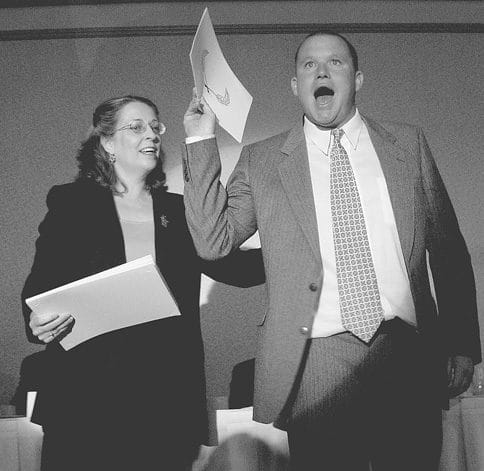
The coalition’s seventh annual “Celebrating Success: From Homelessness to Self-sufficiency and Healthy Lives” event at the Fairmont Miramar Hotel in Santa Monica showed that compassion can lead to success for even the worst of human tragedies.
Two dozen people talked about how they suffered from drug addiction, as well as mental and physical disabilities, but then came from being a blight on society to becoming part of it.
For years they lived on the street but now they have jobs and a place to live. Some even have cars, which for someone who used to sleep under a bridge, is a substantial asset, they said.
The coalition, which is an extensive network of more than 25 local human service, government agencies and faith-based organizations, provides services for homeless and hungry people on the westside of Los Angeles County.
On Friday, more than 300 people gathered to see and hear firsthand the inspirational and life-changing stories of people empowered by the coalition’s services. For the past 13 years, the coalition has built a support network that gives those in need everything from emergency services to mental health and money management services to permanent housing.
The coalition has established a continuum of services that enables people in need to rebuild their lives with dignity and self-sufficiency.
A common theme shared by many of those honored Friday is that vulnerability and one life experience was enough to send them over the edge and onto the street — whether it was the loss of a loved one, the loss of a job, or a mental illness or drug addiction that developed later in life.
Mary Phillips, who was honored Friday, said if it wasn’t for the coalition she would still be on the street. Because the coalition has a variety of different services, counselors were able to assess what Phillips’problems were and get her the help she needed. She was honored for overcoming “multiple barriers,” which included a crack addiction and mental illness.
Phillips went into a tailspin after her spouse died in an explosion at the refinery where they both worked. To deal with the loss, Phillips, 51, turned to drugs.
“It took multiple programs for me because I was hard core,” she said, adding it was years later that she realized she was mentally ill. “I thought I was running on eight cylinders but I only had two.”
“It took multiple programs for me because I was hard core. I thought I was running on eight cylinders but I only had two.” — — MARY PHILLIPS Former homeless woman
William Hargroves, 43, was on the top of his game when he was attending the University of Arkansas. He was drafted by the Houston Astros after his junior year and played pro baseball for three years. But then a severe drug addiction brought him to the streets of downtown Los Angeles. He got help through one of the coalition’s programs three years ago and is now employed, and has a family.
Others who were honored spoke about the challenges they faced while growing up and how life as they know it has always been a constant struggle.
Take Archie Domiquez, a man who ran away from home at 15 years old to a life of crime in the gang and drug-ridden neighborhood of Boyle Heights. But through determination, Domiquez sought help and is now employed and continuing his education.
“We are all faced with adversity but some of us have bigger problems,” he told the group. “I’ve had these dreams before but I never thought I was capable of fulfilling them.”
Originally published in the Santa Monica Daily Press print edition on September 28, 2002. Read the original PDF.