

Camaraderie stressed among SMFD recruits
SANTA MONICA FIRE DEPT. — Three new recruits have shown they can stand the heat, and can breathe a little easier for it.
The trio have sworn to combat fires in Santa Monica, but only after a brutal year of training, testing and finding a way to fit into the SMFD lifestyle.
Twenty-somethings Julian Zermino, Johnny Maccini and Ryan Dermidjian are the newest Santa Monica firefighters, after each passed their one-year test earlier this month. The test, which takes about nine hours to complete, is regarded as one of the most anticipated and rigorous experiences a firefighter in Santa Monica must face.
The year leading up to the test is no cake-walk either. After they passed a written exam, a physical agility test and an oral board review at the outset, the new recruits are on probation for a year. Within six months, they had to have proven that they can handle station life, which is determined by their peers and their captain.
“We can’t afford a guy to be so -so,” said SMFD Battalion Chief Carl Bjerke. “You have to be the kind of guy that can live with others and go with the flow. You can’t have any weird quirks.
“For a year, it’s really up to them,” Bjerke added. “People call it ‘playing the game.’”
Once it’s determined that the new recruits are adjusting well to SMFD life and have bonded with their fellow fire-fighters in the firehouse they’ve been assigned to, it’s time for more studying, testing, training and fitting in.
“It’s so stressful, always thinking about how people look at you,” said Bjerke, a 19-year veteran of the SMFD. “It’s a year of torture. I would never do it again.”
For Zermino, he’s glad he’s off probation and the one-year test is over.
“I was very nervous,” he said. “I was worried about it... it’s your job on the line.”
By the time the one-year test comes around, most recruits are ready for it because the SMFD prepares them daily with quizzes, as well as demanding technical speeches on pieces of equipment and studying lesson plans.
“It’s pretty much every day that we’re quizzed,” Zermino said. “They’ll say, ‘this morning you will give a speech on the chainsaw.’”
Beyond the physical demands of the job and being competent in rescue, fire-fighting and a host of other skills, fire-fighters must memorize every piece of equipment in every compartment of the truck — where it is, how to use it and all of the technical aspects of each part.
“The first year is kind of the last straw, it can make or break you,” Bjerke said. “We’re testing a guy who had a year to prepare for this.”
Conducted at the city yards, the one-year test first requires that recruits start with having to secure their breathing apparatus, which must be done within 60 seconds.
“Some call it an ice-breaker, but it’s a pretty stressful way to start,” Bjerke said.
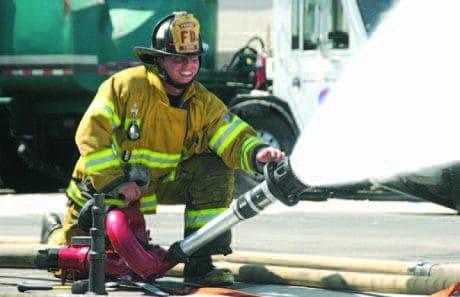
Then it’s on to engine company operations — the different evolutions of fire-fighting — like laying hose above and below ground. The recruits are expected to give technical speeches on every piece of equipment on the truck, down to how many cubic inches are on a cylinder and how many feet of hose there is.
“You name it, that guy will spit it out,” Bjerke said. “It’s really amazing to me. It’s incredible to memorize literally hundreds of pieces of equipment. I had to do that and I’m amazed that I did it.”
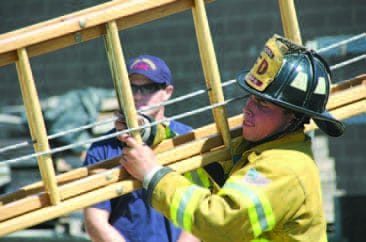
The test also covers laddering, extractions, search-and-rescue operations and belay lines. The recruits also must take a driving test with the fire engine.
The written tests recruits must pass can take between three and eight hours to complete, depending on how prepared the firefighters are. The test is based on close to 50 lesson plans provided by the SMFD over the year.
One recruit this year didn’t pass his one-year test, but Zermino, Maccini and Dermidjian apparently came through with flying colors.
“Now the pressure is lifted from being off probation and they’re so happy to be under civil service protection,” Bjerke said. “It’s a very big sacrifice.”
LOW MAN ON THE TOTEM POLE Once they “hit the floor,” or are assigned an engine company, rookies are considered “junior men,” which means they are Johnny-on-the-spots in their respective firehouses until the next recruits arrive.
“They are kind of banned to do nothing else but study,” Bjerke said. “There’s no downtime, no watching TV with the guys... if the paper towels need to be filled in the bathroom, they better be the ones filling them. If the coffee pot is empty, they better be making the coffee. They have to raise the flag on the flagpole.”
Zermino said the pressure of successfully completing probation is much more than the physical and educational demands.
“The first six months are the roughest because you are on your toes all the time,” the 25-year-old said. “It’s probably the toughest probation I’ve been through because it’s not just knowing the job, but you are expected to do everything...
“At dinner, you are the last one to sit down and the first person to get up. You never get a good meal as a junior man,” Zermino added. “I believe, though, that 90 percent of probation is your attitude.” After the six-month review, the senior firefighters relieve some pressure off of the recruits, but not much.
“They ease off a little bit, but they are still on you,” Zermino said.
In the end, Bjerke said there is camaraderie within the SMFD that results in all firefighters considering one another brothers and sisters.
Bjerke added that when he was a recruit nearly two decades ago, it was a different culture at the SMFD.
“It was psychological torture, but now, it’s a kinder, gentler department,” Bjerke said. “Now, we set them up for as much success as much as we can. Before, it was ‘how much rope can we give this guy to hang himself?’”
“Now, we set them up for as much success as much as we can. Before, it was ‘how much rope can we give this guy to hang himself?” — ’ CARL BJERKE SMFD Battalion Chief
‘THE SANTA MONICA WAY’ Most fire departments in the county don’t test and train as rigorously as the SMFD does, Bjerke said. They also don’t recruit the same, which is designed in Santa Monica to weed out the weak and attract only the most qualified firefighters.
“With a department our size, there’s no room for dregs,” Bjerke said. “It’s a very sought-after job, but it’s not for everybody,” Bjerke said.
The last time the SMFD and the city of Santa Monica created its civil service list, hundreds of people lined up for the job, but only a handful were qualified enough to get on the list.
Three people are interviewed at a time, and if they pass the initial phase of testing and meet other requirements, they’re put on the list. Typically between four and six people are hired at a time, Bjerke said.
The newest firefighters to join the SMFD are the last ones off the list. Zermino applied in 2002, but didn’t get picked up after the first round of initial tests. He was about to throw away his paperwork when he got a call from the SMFD in September of 2004, just before the two-year list was about to expire.
The SMFD and the city of Santa Monica are in the process of establishing a new list, which should be created by early next year.
Bjerke said it wouldn’t surprise him if 5,000 people applied for the six open positions on the SMFD. To whittle down the number of applicants, qualifiers may be instituted that would place higher standards on the test. The SMFD also is considering combining lateral hires — those coming from other fire departments — and the open competitive process, which includes young recruits.
“For the type of job we have, you want a young, fresh guy,” Bjerke said. “But because what we do is so vast, you want a guy that’s good in all kinds of things, construction, engineering...
“We’re hoping on this next test to open it up to a real large cross section.”
Many of them already have either a college degree or have gone through a private academy or paramedic school.
Applicants must meet minimum requirements — they must have an educational background in a fire-service related field, as well as pass a series of initial tests, said SMFD Battalion Chief Dan Matthies, who added the starting pay for a Santa Monica firefighter is $47,000. If they make it past that initial round, they will be subject to a hiring oral exam, which is the applicants’ chance to distinguish themselves from the rest of the pack.
Once they’re hired, the recruits go through a six-week academy created by the SMFD, which teaches the basics of firefighting and is the first introduction to the “Santa Monica way.”
“It all began with the fire academy,” Zermino said. “The first six weeks were tough, physically and mentally.”
Then they’re assigned to an engine or truck company, where they will expand on their training for the next year. They are evaluated every month, until the final day comes for the one-year test.
“You are expected to know so much more now,” Bjerke said. “Every recruit is building on the backs of other recruits and the bar keeps going higher.”
Once they’ve made it into the SMFD, many recruits voluntarily get trained in specialized areas such as search-and-rescue, hazardous materials or homeland security. This week, Maccini was in training for urban search-and-rescue.
“You are always going to school in this profession... we are a small department and you are expected to know everything, they consider us mini-engineers,” Zermino said, adding that Santa Monica is known for its rigorous training programs and its high level of preparedness. “If you put any of our rookies against other departments, we’re far superior.”
Originally published in the Santa Monica Daily Press print edition on September 24, 2005. Read the original PDF.