

Preservation group has seven weeks to raise up to $400K
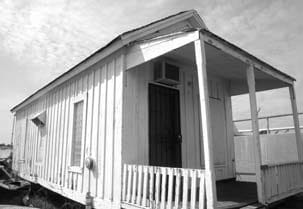
SM AIRPORT — It’s known as a “shotgun” house because a blast fired through the front door would travel through each of its three small rooms and directly out the back door.
The quickly built cottages lined the shores of Ocean Park in the late 1800s and early 1900s. Now preservationists say just one remains. It rests on blocks in a parking lot at Santa Monica Airport, locked in by a sea of new cars stored there by local auto dealers.
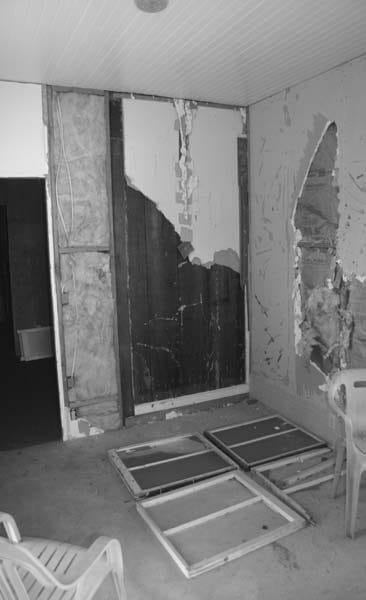
Moving the house to a new location and fixing it up may cost as much as $400,000. Still, move it must: City Hall says the house sits on borrowed space at the future site of a new park.
It was taken there by preservationists in July of 2002 to avoid demolition. The same group that wheeled it across town is hoping to raise enough money to bring the house back to Ocean Park, to a small community garden on the north end of Main Street, where it would be used only by gardeners and mostly for storage.
Doing so may prove difficult. A city report issued last month indicated the preservation group already had let nearly three years go by without formulating a feasible plan. Even with a plan, fundrais-ing would be challenging, the report says, because the house would be accessed only by gardeners, and the gardeners themselves don’t support the move because it would take away one of their plots.
Those obstacles haven’t deterred the subcommittee of a former neighborhood group called the Ocean Park Community Organization. OPCO disbanded more than two years ago and a bitter legal dispute ensued among its members. The committee to preserve the shotgun house, however, apparently remained.
Mario Fonda-Bonardi, an architect and member of the preservation committee who has lived in Ocean Park for nearly 30 years, said Thursday the pre-1900 Victorian house was the oldest remaining example of authentic Santa Monica architecture. No more adobe huts from the mid 1800s. No more of the tent cabins that once were typical of the Santa Monica Canyon, Fonda-Bonardi said.
“They’re kind of the seeds,” he added. “Everything else has sprung up from these seeds.”
Asked how much money, if any, the shotgun committee had raised to save the little house, Fonda-Bonardi replied, “None right now, but we have some good leads. We’ve applied for grants and are waiting for those to come through. We’re pursuing other leads too.”
Moving the house will only cost about $15,000, Fonda-Bonardi added.
“It’s a very small house, like a Winnebago,” he said. “You could put it behind a pickup truck and tow it down the street.”
Though City Hall estimated the cost of moving and repairing the old house at $400,000, one local conservancy official said preservationists may be able to find economies after it’s decided how the house will be situated and what its exact uses will be.
“It (the $400,000 estimate) is obviously is a number that, it raised our eyebrows, but it’s hard for us to say if that’s an accurate number or not without having a historic accountant do a review and have more technical work go into the process. It’s an enormous undertaking certainly, but a very worthy project,” said Joel Brand, president of the board of directors for the Santa Monica Conservancy. The conservancy is a nonprofit organization started by residents in 2002 with a goal to preserve the city's character through its architecture.
Brand is the interim chairman for OPCO’s successor, the Ocean Park Association (see related story), but said he is not affiliated with the shotgun preservation group.
No matter how much money it ultimately takes to save the aging house, the timing will be tight, said Karen Ginsberg, who works in City Hall’s community and cultural services department. Bids for a planned 8.3-acre Airport Park are due April 15, and city officials want to decide by then what to do with the house. Early park plans called for two lighted youth soccer fields, a one-acre dog area, a separate picnic area, a children’s playground, a paved path, restrooms and 116 parking spaces.
Originally published in the Santa Monica Daily Press print edition on March 4, 2005. Read the original PDF.