

Recycling bins to appear on beaches
SANTA MONICA BEACH Efforts to keep plastic bottles out of the water have brought together an interesting alliance of government, non-profit and private entities.
The California Department of Parks and Recreation, the American Chemistry Council and Keep California Beautiful announced the formation of a working relationship between the three state and federal bodies, launching a private-public partnership that pulls the power of each group in the battle to keep the beaches clean of recyclable plastics.
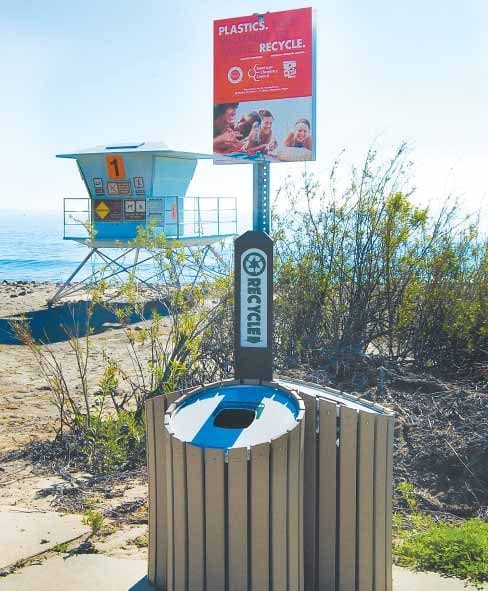
Through the partnership, the American Chemistry Council, which represents the chemical industry including producers of plastic, will supply recycling bins to California state beaches, each container reading: “Plastic. Too Valuable to Waste. Recycle.”
The partnership was developed in part by Keep California Beautiful, a Sacramento-based non profit organization that promotes source reduction and anti-litter education and helps develop private-public partnerships at the state and regional level.
“We hope it means less litter and a more educated public to producing less later,” Roy Stearns, spokesman for the Department of Parks and Recreation, said.
Stearns added that in light of the state’s budgetary situation, private-public partnerships have been explored to use private funds for the public good.
The program is being conducted at no cost to taxpayers, Stearns said.
“They pay the cost of putting these bins out there and we get the benefit of people helping to keep our places cleaner,” Stearns said.
Approximately 400 bins have already been placed at 16 beaches statewide, including Leo Carillo State Beach in Malibu on Feb. 8. Officials say a bin could also be in the future for Santa Monica State Beach.
“Plastics don’t belong on beaches,” Sharon Kniese, vice president of the products division for the American Chemistry Council (ACC), said. “We wanted to be part of the solution.”
Roughly 76 million people visited state parks during the 2005-06 fiscal year, many of which traveled up and down the coastline.
In 2006, 7.8 billion units of clear plastic, which is often found in the form of water and soda bottles, were sold, while approximately 3.65 billion, about 46 percent, made it back to the recycling centers.
“It’s a great opportunity because budgets are tight and state parks are a great valuable resource and venue and a lot of people go to public parks and take with them items that are highly recyclable and they need access to bins with signage,” Christine Flowers- Ewing, the executive director of Keep California Beautiful, said.
With many municipalities considering banning plastic bags from grocery stores, plastic has been the target of much criticism, receiving a lot of bad PR.
But while plastic has gotten a bad reputation, it’s a preferred choice when considering the alternatives, using less energy, greenhouse gasses and generating less emissions.
“When you look at the alternative, they are the environmental choice,” Kniese said.
Mark Gold, the executive director of Heal the Bay, said that while it’s good to have more recycling opportunities on the beach, the key to the solution is not just recycling.
He added that the American Chemistry Council is the same organization that has challenged Heal the Bay on all marine debris-related legislation, and the Styrofoam and plastic bag ban efforts.
“Source reduction is obviously the key to solving the marine debris problem,” Gold said. “You can’t recycle your way to a solution.”
Originally published in the Santa Monica Daily Press print edition on February 15, 2008. Read the original PDF.