

By MICHAEL TITTINGER Daily Press Staff Writer
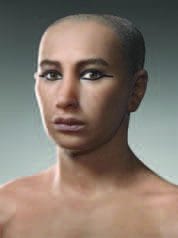
MIRACLE MILE — Young, power beyond all measure, and certainly a thing for the bling-bling — Tut, as they said in years past, was indeed the “mutt’s nuts.”
Today, Tutankhamun would be a rock star, a veritable “Golden God” with ample reality show gravitas, adored by prepubescent girls and Bravo viewers alike. Instead, he had to settle for being King of Egypt during the 18th Dynasty, ruling much of the civilized world and getting fanned ad nauseum by a gaggle of groupies.
Proving once again that nothing so attracts as youth, the boy king is still reeling them in. By flail or by crook, gawkers by the thousands are filing into the Los Angeles County Museum of Art exhibit “Tutankhamun and the Golden Age of Pharaohs” — the first such showing of Tut’s golden goods in the United States since the mid ’70s.
Like Billy the Kid or Alexander the Great or James Dean, Tutankhamun will never get old, nor will the pull his tomb accompaniments hold over us in all their gilded luster. But if you learned as a kid of the opulence beyond comprehension bestowed upon the boy king following his untimely death at the age of 19, you might be disappointed to learn the most prized of his precious objects — such as his three golden coffins, placed inside one another like Russian matryoshka dolls — are not lying in state north of Wilshire Boulevard.
Still, there’s much to take in at the exhibit, if you have the time and don’t mind making some elbow room for yourself among the mommies and mummies. Be prepared to say “sorry” and “excuse me” repeatedly, as the crowds can often swell inside of LACMA’s display rooms, and the A.D.D. contingent gets ornery.
But the continual stream of onlookers is testament to the enduring power and fascination we have with ancient Egypt, and the unparalleled preparations they made for the afterlife. Even if you don’t know your Amenhoteps (kings before Tut) from your canopic jars (used to store embalmed organs), the exhibit is worth a gander.
LACMA does a nice job of enclosing each piece in a display case viewable from 360 degrees, allowing extended looks from every vantage point, be it over a senior’s head or under a tourist’s ball cap. The exhibit also gets increasingly darker, providing a heightened sense of foreboding as you work your way toward the really good stuff, akin to exploring a tomb.
Some of the highlights include the golden Coffin of Tjuya (complete with lid intriguingly ajar), golden-laced crooks and flails (which people don’t seem to tote around much anymore) and a room full of jewels taken from Tut’s own mummified remains.
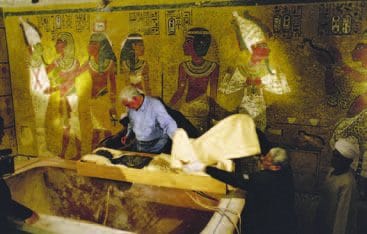
After having entered the tomb following his discovery in the Valley of the Kings in 1922, the British archeologist Howard Carter recalled the scene as “everywhere … the glint of gold.”
Who living in the town of tinsel can’t appreciate that?
“Tutankhamun and the Golden Age of Pharaohs” runs through Nov. 15 at the Los Angeles County Museum of Art.
Originally published in the Santa Monica Daily Press print edition on August 12, 2005. Read the original PDF.