

Residents thankful plans back on drawing board
SUNSET PARK – Imagine a light rail line ending at the site of a future Santa Monica Place, a spanking-new 10-acre destination point for Santa Monicans and tourists alike. A walkway winding its way to the Promenade is lined with outdoor European-style cafes, shops, restaurants and multi-story housing overlooking the Pacific Ocean.
Some residents said such a downtown in Santa Monica should not be too far-fetched. They were participants in Monday night’s “Re-Imagine Santa Monica Place” workshop staged at Grant Elementary School.
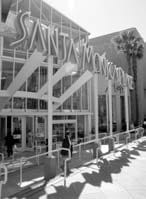
The “Re-Imagine Santa Monica Place” program consists of a series of public workshops, sponsored by City Hall, to determine how to re-develop the downtown indoor shopping mall between Broadway and Colorado Avenue and Fourth and Fifth streets.
Randy Brant, Senior Vice President of Leasing and Development for Macerich, Inc., which owns Santa Monica Place, said the current site needs to be re-developed because it was based on an old, outdated suburban model that does not compete well with shops along the Third Street Promenade.
“Leasing at Santa Monica Place is not faring very well primarily because retailers have realized that customers coming to Santa Monica are interested in an outdoor, urban lifestyle that the closed mall environment doesn’t provide,” Brant said.
The question of what kind of development should replace Santa Monica Place is one the city has grappled with in recent years, prompting the public workshops.
The City Council scrapped a proposed development to replace Santa Monica Place last year due to outcry over the height of high-rise buildings slated for the site. If implemented, the project would have demolished the existing mall and erected three 21-story residential towers, an eight-story office building and an eight-story apartment building. Those buildings were to be built on top of a new outdoor mall, which developers described as a natural extension of the Promenade.
Assistant City Manager Gordon Anderson said the city has been authorized by the City Council to spend between $150,000 and $250,000 to hire consulting firms Moore Iacofano and Keyser Marston Associates to facilitate the creation of a project that falls within nine council-directed guidelines intended to better satisfy the public’s vision for the Santa Monica Place site.
Moore Iacofano representatives are hosting the workshops, with city staff and Macerich representatives on hand to answer questions. Keyser Marston Associates will then do an economic feasibility study in tandem with city planners to determine the pros and cons of concepts for the site that originate from the public discussion.
These replacement concepts will then be presented to the City Council and the public for final approval, according to Anderson. Macerich, the developers, will then reimburse the city for the costs of the consulting services.
Several participants at Monday’s workshop said they appreciated the opportunity to take part in the development process. Some remained skeptical, but others said they were optimistic their ideas will be incorporated into the final project.
“We have an opportunity to try for something original,” said Santa Monica resident Tony Gwilliam. “The opportunity for something by the people, instead of your standardized GAP store on every corner. I’d like to see more of the old city style of living, in which the butcher lives above his shop and artists live next to their studios.”
Among the concepts participants wanted to see implemented include: pushing parking a block or two away from the Santa Monica Place site and the rest of the Promenade; a shuttle service to transport shoppers; using more innovative parking solutions in the city in general, such as submerged structures or structures on the beach; continuing to externalize Third Street decorative style; paying increased attention to density and traffic impacts; more greenery and community space; and creating spaces for use that may or may not have a direct commercial tie-in, such as a childrens’ play center, museums, monuments or an open gym.
“Let’s give Santa Monica more of an international flavor,” said Jim Leonard, a local resident of 35 years who works as a pastor in West L.A. “Let’s make it attractive, not just for shopping, but for other forms of recreation.”
Leonard said he would like to see a museum at the future Santa Monica Place site.
Santa Monica resident Gizelle Stronkendl agreed there needed to be more recreation options available.
“Santa Monica is a destination for many people because of its ocean views,” Stronkendl said. “We need the kinds of places that will allow people to enjoy the ocean views, such as terraced buildings and outdoor cafes.”
Still, some residents had reservations about the proposals. Geraldine Kennedy said plans that included accommodating a light rail system did not yet have a place in the discussion.
“This site could be redeveloped again before we see a light rail in place,” Kennedy said. “There’s been no money approved for it yet. It’s a pipe dream.”
Santa Monica resident Bob Gabriel emphasized the need for participants to be pragmatic.
“People need to keep in mind that either the developer will have to pay for the project, or the city will,” Gabriel said. “Unless they want to raise taxes, people can’t demand too much of developers, because developers can only dig so deep into their pockets to make a project work.”
“We need something in place that makes sense for all sides.”
Santa Monica resident Denny Zane said he supported a pragmatic approach.
“I want to see the honest choices here,” Zane said. “I want to see a renovation of the existing facilities that make it open air. I want them to re-do the ground floor so it opens up for pedestrians, with a minimal level of investment before demolishing and starting new. Why spend $100 million, when problems might be solved with much less?”
The series began Sunday afternoon at Santa Monica Place and continued Monday night at Grant Elementary School. The next meeting will be held at 6 p.m. on Thursday, March 17, at Franklin Elementary School. A final meeting will be convened at 6 p.m. on Monday, March 21, at John Adams Middle School. More than 120 Santa Monica residents participated in the Sunday meeting, which lasted more than seven hours. More than 30 residents participated in the three-hour fete on Monday.
The nine council guidelines for the site include ensuring the appropriate amount of housing is available, including a significant proportion of affordable housing; maximizing public parking; maximizing open space to function as true public space; designing at a human scale with strong pedestrian orientation; demonstrating clear advantages of increased heights; promoting economic egalitarianism; ensuring extensive sustainable design and construction; ensuring integration with broader transit, parking and circulation strategies; including an appropriate orientation towards future light rail; and ensuring a project that is economically sustainable for the applicant and the city.
Originally published in the Santa Monica Daily Press print edition on March 16, 2005. Read the original PDF.