

REED PARK — Shakespeare has arrived in Santa Monica.
In true community theater format, Shakespeare Santa Monica, in association with the Powerhouse Theatre Company, has returned for a second year to offer residents free performances in the park, specifically in the Miles Playhouse and on the tennis courts at Reed Park.
“All’s Well That Ends Well” opens tonight at the Miles Playhouse, under the direction of Louis Scheeder, the director and founder of The Classical Studio at New York University’s Tisch School of the Arts.
“Romeo & Juliet,” directed by John Farmanesh-Bocca, will debut on July 21 at the playhouse. Both shows will run intermittently through July 31, with four days of outdoor performances set to begin on July 28 on tennis court No. 1.
The outdoor performances are an attempt to reconnect with the roots of community theater, which were largely held on grass tennis courts and lawns as early as the 1500s.
Last year’s inaugural production of “Much Ado About Nothing,” also directed by Scheeder and performed at Reed Park, attracted about 1,000 people of all ages within the community.
This year, Farmanesh-Bocca, the founding artistic director and producer of Shakespeare Santa Monica, hopes the two productions attract a combined 3,000 people. His dream is to grow the community theater production in Santa Monica so that it eventually has multiple venues, possibly even on the beach and at other parks.
“Free Shakespeare is a cultural phenomenon that every world-savvy community should have,” Farmanesh-Bocca said. “I was interested in doing something in Santa Monica because I wanted to fill that vacancy.”
Farmanesh-Bocca has assembled a company of young and established talent from both coasts to present Shakespeare in what he describes as a vital, rigorous and contemporary style.
The 25 actors and their mentors arrived in Santa Monica at the end of May, training and rehearsing ever since.
“Just because it’s free doesn’t mean it shouldn’t have the highest quality,” Farmanesh-Bocca said, adding he strives for the same caliber of performance as what’s seen on stages off-Broadway and in the south of London. “Although our production values are modest, we try to be as absolutely elegant as possible.”
The company focuses on training actors as its first goal, with live performances being offered in Santa Monica as a bonus for both participants and residents. The actors, some of whom are theater graduates and working professionals, and others who are still students, paid between $10 and $15 for each of the 70 hours of training they received prior to rehearsal.
Company members spent the first three weeks in training and another three and a half weeks in rehearsal, for a combined total of 100 hours of painstaking, detailed work under the direction of some of the best theater and drama instructors in the country.
To receive the kind of instruction from a professor of Scheeder’s caliber would require spending nearly $60,000 for two years at NYU, before making it into his class — since he only teaches third-and fourth-year students, Farmanesh-Bocca said.
Farmanesh-Bocca is a graduate of NYU’s Experimental Theatre Wing and just finished a two-year directing fellowship at The Juilliard School in Manhattan. Combined, the two directors have decades of experience both on and off stage in theater production throughout the United States and in other countries.
Actors involved in this year’s production say the instruction from Scheeder and Farmanesh-Bocca compliment one another.
“Louie’s style is very simple — you play actions, you breathe, you drop your jaw,” said Danielle Levanas, who studied under Scheeder at NYU and plays Juliet in the Santa Monica production. “He seems to be traditional, but he’s not. He’s open to anything.”
Farmanesh-Bocca, who studied under Scheeder and describes him as one of his mentors, said Scheeder loves to work and is straightforward in his teaching. At the same time, he challenges his students.
“He begs actors to argue with him so he can win,” Farmanesh-Bocca joked.
Camron Robertson, who plays Bertram in “All’s Well That Ends Well,” said that technique works well in challenging him to be a better actor. “(Scheeder) does a really good job of showing you how it works,” Robertson said.
Actors receive comprehensive instruction in voice, acting and text, as well as learning how to play actions, move on stage, access emotions and feelings and learn how to perform verse, which in Shakespeare plays, is especially detailed because it deals with the iambic pentameter — the building block of poetic forms and a rhythmical pattern of syllables. The “iambic” part means that the rhythm goes from an unstressed syllable to a stressed one, while the “pentameter” part means that the iambic rhythm is repeated five times.
To master that art, actors spent two weeks receiving direction from Ralph Zito, chairman of the voice and speech department at The Juilliard School of Drama.
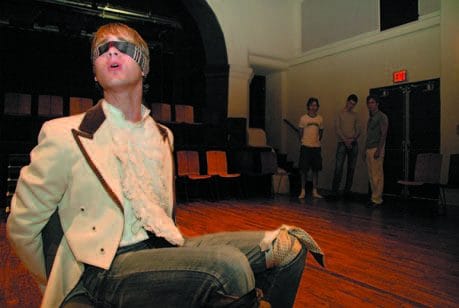
The rest of the training comes from Scheeder and Farmanesh-Bocca, who are meticulous in their work. At rehearsal earlier this week, Scheeder commanded the upstairs of the Miles Playhouse, working and reworking the actors’ physical presence on stage. Meanwhile, Farmanesh-Bocca sat around a table downstairs with other performers repeatedly going over pronunciation of verse, particularly the “O,” for hours.
“There is a lot of verse work... word by word, thought by thought, line by line,” Farmanesh-Bocca said. “We start at the table, pause at a line of 10, so they can start a new thought... it assists the actors to see what they are feeling on stage and it helps them so they don’t get up in front of a group and lock up.”


Originally published in the Santa Monica Daily Press print edition on July 14, 2005. Read the original PDF.