

A stellar cast carries the day in “Runaway Jury,” an imaginative courtroom drama based on a novel by John Grisham (“The Firm,” “A Time To Kill”). Dustin Hoffman, Gene Hackman, Rachel Weisz and John Cusack are the big names deftly working all sorts of angles in this gordian knot of a thriller about a ruthless trial consultant pitted against a high-minded attorney, and an opportunistic couple that offers to deliver the jury to the highest bidder.
Ayoung widow seeks retribution from a powerful weapons manufacturer after her husband is gunned down at his office. Her attorney, Wendall Rohr (Hoff-man), is a courteous Southern gentleman who’s not afraid to take on the corporate heavies, confident he can rouse any jury’s sympathies. Ah, but Wendall is in for a surprise — the gun company has hired legendary jury fixer Rankin Fitch (Hackman), a master manipulator with an uncanny knack for securing his clients the verdicts for which they pay him so handsomely.
Fitch and Rohr soon realize, however, that they’re not the only ones out to influence the trial. A juror, Nick Easter (Cusack), and his crafty partner Marlee (Weisz) assure both sides that they control the tribunal, and open the bidding for the verdict at $10 million. This sting doesn’t sit well with Rohr, whose morality is put to the test, or Fitch, who’s not the sort of man to be hustled. Of course, all is not as it seems, as we discover when the third act unfolds and the players’ real motives are revealed.
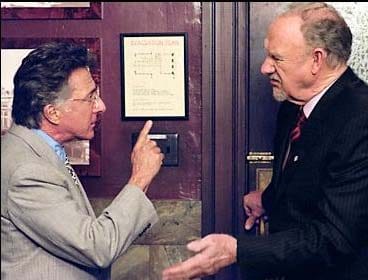
A heist movie set in a courtroom isn’t something you see every day, and it’s a clever experiment that pays off handsomely. This is, arguably, the best adaptation of a Grisham novel yet. “Runaway Jury” is full of surprises, among them that the film marks the first on-screen collaboration of Hackman and Hoffman, who have known each other since the late 1950s. It’s been a long time coming, and the pairing was worth the wait — especially when Rohr and Fitch square off in a courthouse bathroom. Cusack and Weisz both do fine jobs, though not even actors of their considerable talent can sell the hokey finale, where we’re unwieldy reminded that guns are bad. It’s the only misfire in a film that’s otherwise dead on. (Rated PG-13 for violence, language and thematic elements.)
Originally published in the Santa Monica Daily Press print edition on October 17, 2003. Read the original PDF.